A starter kit of three tools and nothing else
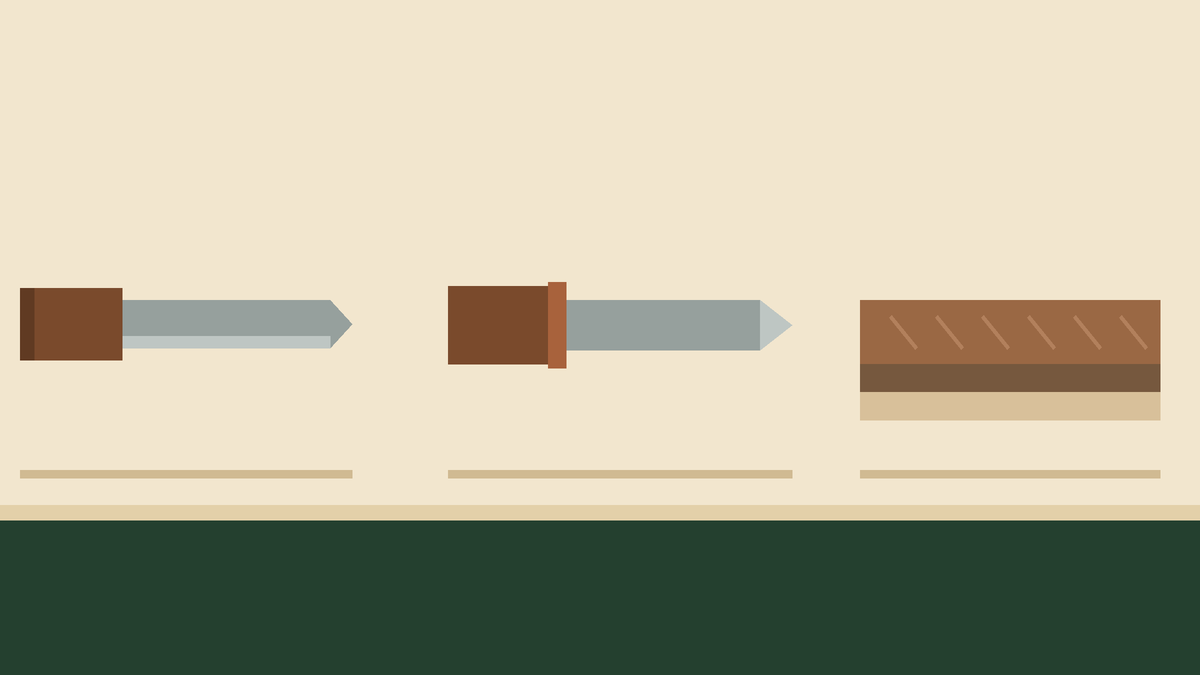
The twelve-piece boxed set is the most common first purchase in carving and one of the worst. It arrives with nine tools you will not use for two years, three you will, and an edge on all of them that needs work before anything cuts properly. Buying three good tools instead costs about the same and skips the disappointment.
The sloyd knife
One straight blade, roughly 60 to 70 millimetres long, with a handle thick enough to fill the palm. This does perhaps eighty per cent of the work in small carving: all four basic strokes, roughing, shaping and finishing.
What to look for is a blade ground thin behind the edge. Thickness there is what makes a knife feel like it is wedging through the wood instead of slicing, and it is the single biggest difference between a knife that flatters your technique and one that fights it. A laminated carbon steel blade is the traditional answer and takes a keener edge than stainless, at the cost of needing to be wiped dry.
Handle shape matters more than most people expect, because a carving session is a long sequence of small grip changes. An oval handle tells your hand where the edge is pointing without looking; a round one does not.
The shallow gouge
A number 5 or number 7 sweep, around 12 to 16 millimetres wide. This is the tool for hollows — the inside of a spoon bowl, the dish of a small tray, any concave surface a straight blade cannot reach.
Shallower sweeps are more versatile than deep ones. A number 5 can cut a shallow hollow directly or, tipped on its corner, act as a skew for cleaning up. A deep number 9 does one thing well and nothing else, which is why it belongs to a later purchase rather than a first one.
What the numbers mean
The sweep number describes the curvature of the cutting edge, from 1 (flat) to 11 (a full half-circle veiner). The width in millimetres follows it, so a #5 x 14 is a moderately curved gouge fourteen millimetres across.
Two numbering systems exist and they disagree slightly, so look at the profile drawing on the supplier's page rather than trusting the number alone.
The strop
A flat piece of leather glued to a board, charged with a polishing compound. This is not optional and it is not the same as a sharpening stone. A stone reshapes an edge; a strop removes the microscopic wire edge left behind and realigns the steel, and it is what keeps a knife carving well between actual sharpenings.
Thirty seconds of stropping every fifteen or twenty minutes of carving means the edge never gets dull enough to need the stone. Carvers who skip stropping end up sharpening constantly and wondering why their tools feel worn out.
What to add next, and when
Add tools when a project demands one, not before. In practice the fourth tool is usually a V tool for lines, the fifth a narrower gouge for detail, the sixth a hook knife if you decide spoons are your thing.
That sequence takes most people a year or more, and each addition arrives with a clear reason attached. A shelf of tools bought for reasons that never arrived is the more common outcome, and it teaches nothing.
Budget, honestly
A good sloyd knife, one gouge from a reputable maker and a homemade strop land somewhere near the price of a mid-range boxed set. The difference is that all three will still be in use in ten years, and the edges will be worth maintaining.
If the budget is tight, buy the knife first and carve with only that for a month. It is a complete tool on its own, and the constraint teaches more about stroke selection than a full rack ever would.